
From Cranwell to Tobruk!
Contributed by Ian Seeley son of the correspondent
November 1940 Liverpool

RMS Strathnavar
A dull November evening. The dark bulk of RMS Strathnavar dwarfed the troop train as it pulled on the greeting dock opposite the Liverpool Liver building. Cranwell seemed a light year away. Leave, a faint memory as was RAF Wilmslow, the kitting out and first hint that the cream of OM 10B was bound for warmer climes.
H deck on the Strathnavar was just above the screws – any lower and we felt we’d be in there with them. It also struck the more pessimistic among us that it was a long way up a lot of ladders to reach daylight if disaster struck. For the present, we were too busy learning the geography of the mess decks – the mysteries of hammocks and where to sling them, and where to draw the rations.
Morning brought a sense of motion, and climbing to an open deck we found the ship moving to sea under leaden skies, barrage balloons fluttering from shore, and various ships, and minesweepers ahead sweeping the lane against any overnight mine-laying.
We headed North and West picking up other ships and as the convoy formed we were aware of the escort destroyers, among them the four funnelled US handouts Churchill had negotiated in exchange for West Indian bases. It made one pity the matelots aboard them. In mid-Atlantic they all but looped-the-loop and frequently disappeared amid waves twice the height of their superstructure.
We were the biggest ship in the convoy – some 30,000 tons plus, I believe, and carried the Commodore. To starboard was a new Cunarder, RMS Andes on her maiden voyage, and some 20 other ships in a high speed, 20 knot convoy – speeding to outstrip the U-boats (although at the time I cannot remember even thinking such things). A daily amusement was watching a team of army gunners exercising on the afterdeck an antiquated 6-inch gun which was all the defence provided; plus a guess at the daily ships mileage.
First port of call – Freetown. We anchored near a battleship showing signs of damage (from the episode at Dakar when the French Navy was ‘taken out’ to prevent significant ships falling into German hands – so we heard). Freetown – jungle, jungle everywhere. Bunboats near the ship selling fruit – not a healthy place.
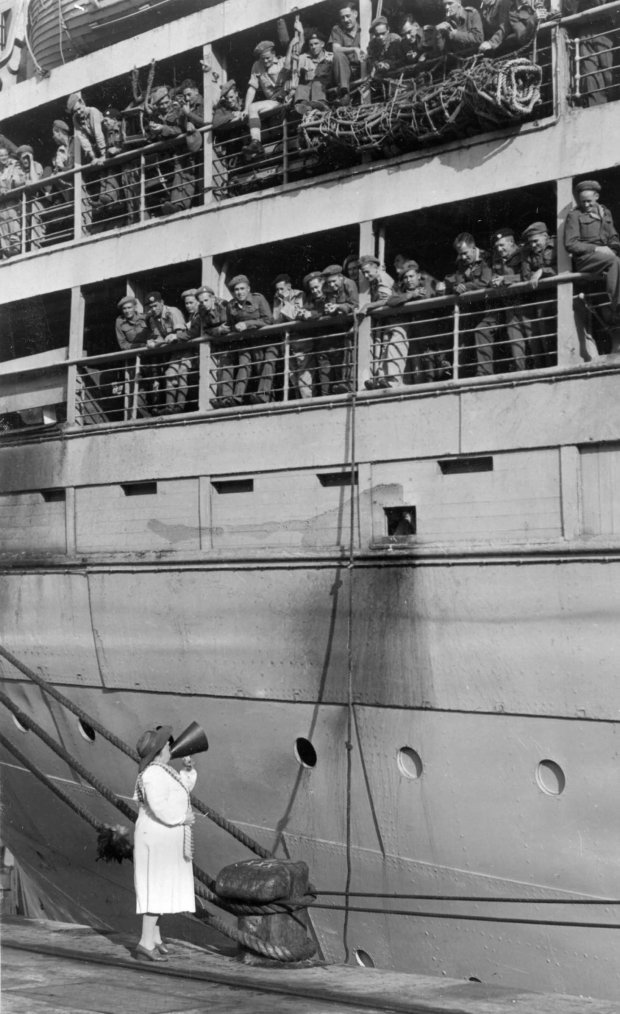
So on South of the Line, round the cape to Durban – greeted by the ‘Lady in White’ singing on the quayside – she greeted all the convoys.
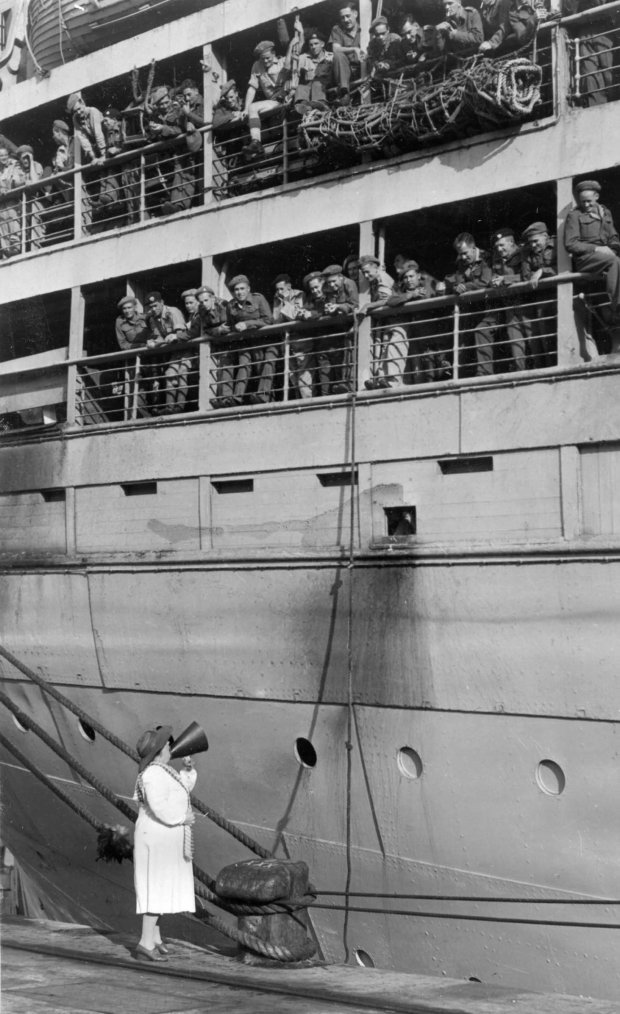
The harbour waters were filled with wall to wall jelly fish – swimming not recommended. We were allowed daily runs ashore. Jack Crabbe and I took a bus to the end of the route in one of the residential suburbs. Within five minutes of walking past neat houses we were invited in and treated like VIP’s. Lieutenant Craddock was an instructor at the Durban Signals School, RSAN. His daughter showed us the sights including our first drive-in cinema. At night – back to the ship by rickshaw – all very pleasant.
On Dingaans Day (anniversary of when the Zulus defeated the Vootrekkers), the Zulus all had a holiday – except for the rickshaw boys, who donned their feathered headresses and the white population kept out of their way.
After several days, replenished ships and refreshed bodies, the convoy headed North. Next stop, Aden – brief run ashore. (A first lesson in the craftiness of Indian traders – I bought a nice shirt, carefully selected – when I got back to the ship I found a different one with a hole in it!).
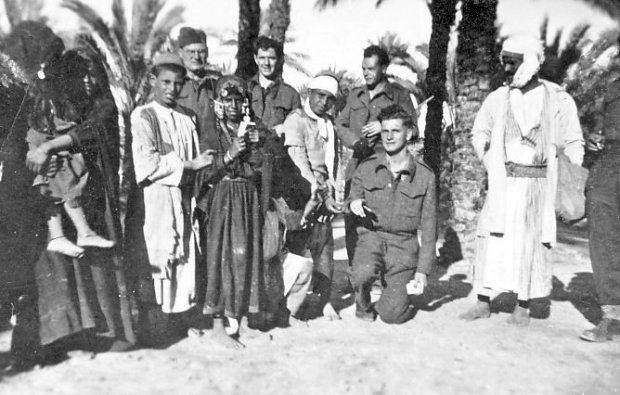
Abu Sueir 1941
On to Suez, and after six weeks glad to be finally ashore, and by train arrived at RAF Abu Sueir 107 MU, near to Ismalia, where we were on hold until our postings were sorted out. Finally, Hicks and I were on our way to 73 Squadron somewhere in the Western Desert. By train to Mersa Matruh – after leaving the Delta, scenery nil, wooden seats, slow and saddlesore by the time we reached Mersa Matruh; then by an ex-Italian coastal steamer to Tobruk.
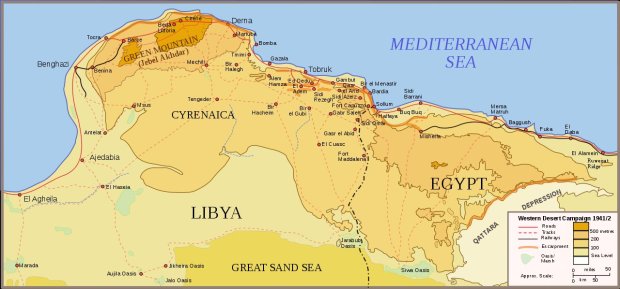
At this time the front line was way beyond Benghazi, with the Iti’s on the run. Some of us spent the night in a cave to wake in the morning to find ourselves next to large barrels of
red wine and cognac, a mug of either before breakfast was found not the best idea. However, a truck arrived to take us on to 73 Squadron which we found to be at Gazala. Twelve Hurricanes Mk 1 to be uncovered, desanded, and DT’d each day. TR9B technology, the battery changing trailer about the most important vehicle after the bowser (A Bowser is a trailer fitted with a tank which can carry Water, Diesel, Adblue, Kerosene, Aviation Fuel or Petrol). Water in short supply. The Iti’s were surrendering to whoever would have them. Our cook, with the ration truck, brought in about 50 (all singing cheerfully, including one who carried the cook’s rifle for him, so I was told).
So Marshal Graziani and his Italians were in total retreat, and on 20th February 1941 73 Squadron was ordered back to Egypt (rumour had it that we were off to Greece), so we drove back to Doraya (near Alexandria), via Tobruk, Bardia, Sol-lam, Sudi Barani and Marsa Matruh (20th to 21st February). Henceforth known as ‘The Dummy Run’ because at the date of arrival in Auraiya Greece was folding up as was Crete (some we knew arriving from the area described how they had been included in an army squad in Crete and had to bayonet charge their way down to the beach where the Navy was waiting). At the same time Rommels Africa Korps was ashore in Libya and pushing into Cyrenaica. So back the squadron flew to Gazala which our road convoy reached on 25th February.
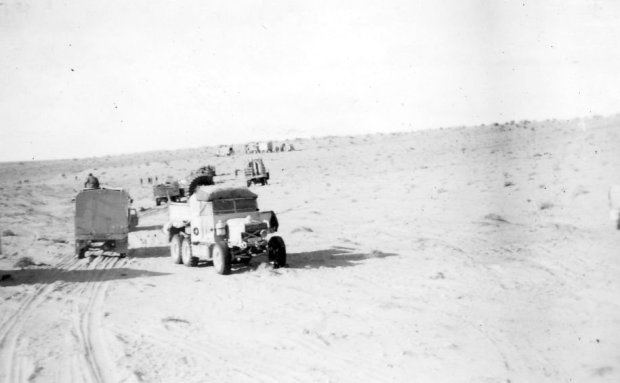
73 Squadron – soft sand nr. Sidi Azzab
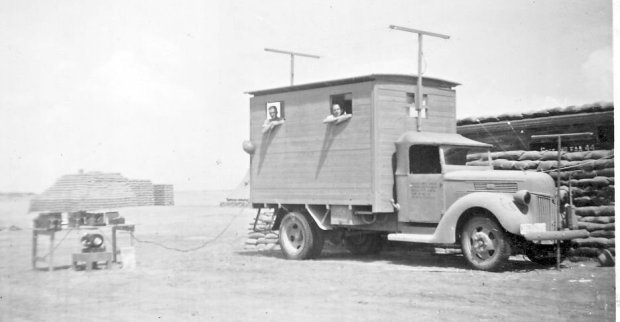
Signals Advance Party
Port Said 1941
From vague memory flying operations continued for two weeks or so, until we were ordered to move east to Bin Aanred (11th March) and on to Buq Buq (I think near El Adem) 9th April. Divebombing by Ju 89’s (Stukas) and strafing by IME 109’s was hotting up. The aircraft flew to Tobruk and we hit the trail again directed by a British Military Policeman (who we later discovered was a German in disguise). We steered east and were less than thrilled to see tanks ahead of us – with black crosses on the side and looking uncommonly like German Tigers. Our trucks all reversed direction, and were saved when a squadron of Hussars Valentine light tanks bravely interposed themselves between us and the Tigers, their commander waving and shouting to us to get the hell out of it! We made it inside the Tobruk perimeter on Good Friday 11th April. How many of the Hussars survived I couldn’t guess – except not many. They were heading towards the tank battle at Sidi Rezegh where our losses were very high.
The Tobruk perimeter was manned by the Australian Divison who were not going to let the Germans gain an extra inch. The aircraft were reduced to a mere handful flying from the airstrip at El Gabi on top of the escarpment on the east side of the harbour. One by one the remaining Hurricanes were shot down or strafed while refueling and rearming. The last three I seem to remember were flown by Free French pilots.
So for most of the next six weeks we were incarcarated without a job. A sort of routine was set up.. Australians came out of the front line to recover the Browning 303 machine guns from our wrecked Hurricanes. Every morning about 0800 ‘Bardia Bill’, (the nickname of an Italian large size gun) threw a shell or two whistling over our heads into the town beyond the harbour from 20 miles away (damage done almost always slight). And the Stukas divebombed anything that seemed worth a shot and we all fixed up quite comfortable bunker positions from which to take pot shots at them. The middle of the day was generally quiet so we went swimming.

In the evening we made friends with the kangaroo rats and listened to the BBC news. The ubiquitous TR9B from the aircraft could be tuned to the overseas service, and with a bit of addition to the output strength, and a primitive loudspeaker, reception was generally quite good.
On one occasion the Aussie publicity man who was producing a daily news sheet from the BBC had problems with his radio, so used mine, and so I got a copy of “The Tobruk Truth” – the Dinkum Oil (honest truth) for that day.

One morning we awoke to find a changed scene in the harbour. HMS Ladybird, a Yangste river gunboat had been sailed all the way from the China Station to increase Tobruk fire power. It didn’t last long. Its long 15 inch gun and considerable secondary firepower were no doubt effective while things lasted, but almost immediately the Stuka began stystematic attacks and within a day or two HMS Ladybird was sunk. (It was fortunate during the ‘Dummy Run’ we had time to shop a bit, and I got camera and film to record these episodes).
An occasional bit of light relief was offered in an evening when a truck would take some of us (after dark) to the town where in a fairly undamaged building the Aussie Church Army set up shop. On offer was hot cocoa and biscuits – but you had to sing hymns first, evangelist type, well known hymns to modern swinging tunes.
With the perimeter closed up tight and the Aussies holding back the Germans we finally left Tobruk on 28th May. Dead of night, down to the Egyptian minesweeper, coal fired, filthy, overloaded, took us off. We just lay on the deck wherever a space offered. Morning found us off Marsa Matruh and by the end of the day we had rejoined the rest of the squadron at Sidi Haneish.
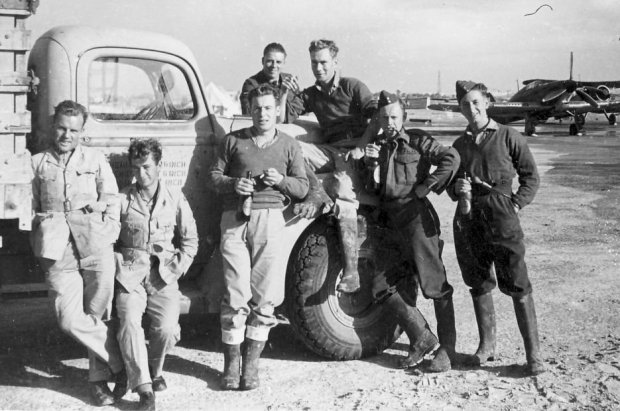
Dirheila Christmas Day 1941
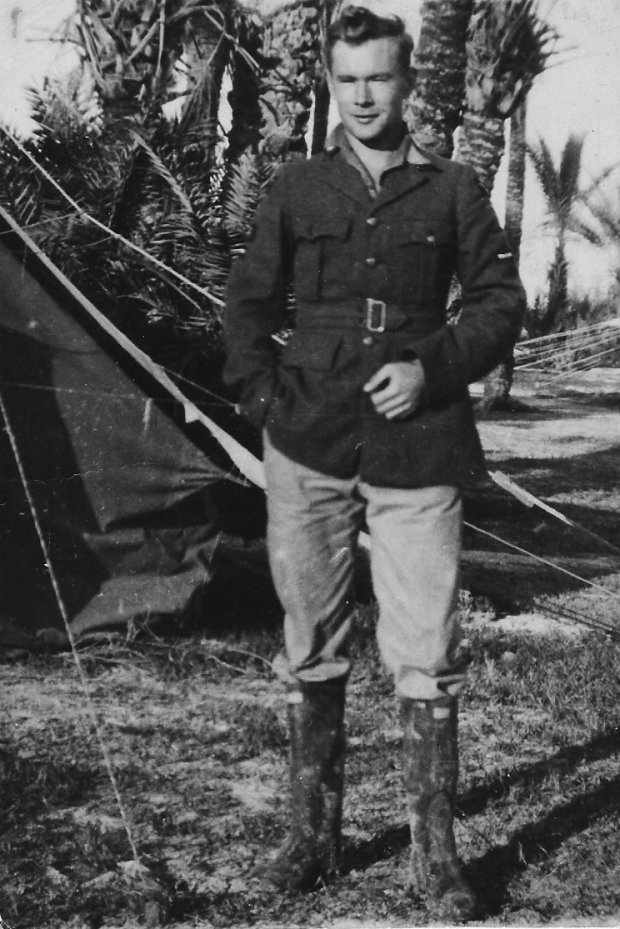
Appendix 1
38th Entry: Of the 1300 boys in the 38th Entry who arrived at Halton in August 1938, several hundred were transferred to Cosford and Cranwell. However, on the outbreak of WW2 those at Cosford returned to Halton. Hence the Cranwell and Cosford hatband colours. The 38th served the shortest apprenticeship in the history of the school being dispersed to operational stations in April 1940 after only 20 months of training in time to take part in the Battle of Britain.
Appendix 2
Perla Siedle Gibson was a South African soprano and artist who became internationally celebrated during the Second World War as the Lady in White, when she sang troopships in and out of Durban harbour.
Appendix 3
RAF 73 Squadron
……the Luftwaffe, joined the Desert war and for many months 73 found themselves hard pressed against a formidable opponent. Twice the Squadron narrowly avoided capture in the Tobruk pocket, on one occasion actually watching the approach of Rommel’s tanks. During this time the airmen on the Squadron found a dump of serviceable Italian motor-cycles and for a while the whole Squadron was mobile! In May 1941, six of the Squadron’s Hurricanes flew to Crete to assist in the desperate fight for that Island. On their return to base in Egypt, astonished ground crews saw two pilots climbing out of one Hurricane! The pilot of the aircraft had flown from Crete sitting on the knees of another whose aircraft was destroyed. Among the colourful personalities on the Squadron at this time were Lt. Littolf, a Free French ‘ace’ who destroyed 14 enemy aircraft, and the C.0. of the Squadron, Sqn. Ldr. WykehamBarnes (now Air Marshal P. Wykeham, C.B., D.S.O., O.B.E., D.F.C, A.F.C.). There was also Sqn. Ldr. ‘Monty’ Ellis D.F.M., who early one morning shot down 3 JU 88’s then returned to base to join the queue for an early but meagre breakfast. The advance of the Eighth Army through North Africa saw 73 well up with the front line, ground straffing and giving Montgomery’s troops every assistance. In December, 1942 the Squadron recorded their 300th victory when F.S. Beard shot down a JO 88 over the sea of Benghazi. The defeat of Rommel’s Afrika Corps sounded the death knell for Hitler’s ambitions in Egypt. No. 73 Squadron moved across the Mediterranean to the toe of Italy – now equipped with Spitfires.
In early January 1941 73 Squadron began operating on its own account. On 14th April the squadron took off to intercept CR42 and G50 fighters attacking Tobruk. Smith single-handedly attacked five G50s and shot down two and damaged a third before being shot down and killed.
Appendix 4
“………the US sent a proposal to London through the British Ambassador, the Marquess of Lothian, for an American lease of airfields on Trinidad, Bermuda, and Newfoundland.[5] British Prime Minister Winston Churchill initially rejected the offer on May 27 unless Britain received something immediate in return. On June 1, as the defeat of France loomed, President Roosevelt bypassed the Neutrality Act by declaring as “surplus” many millions of rounds of American ammunition and obsolescent small arms, and authorizing their shipment to the UK. Roosevelt initially rejected Churchill’s pleas for destroyers for the Royal Navy.
President Roosevelt approved the deal on the evening of August 30, 1940.[6] On September 2, 1940, as the Battle of Britain intensified, Secretary of State Cordell Hull signaled agreement to the transfer of the warships to the Royal Navy. On September 3, 1940, Admiral Harold Stark certified that the destroyers were not vital to the security of the US. In exchange, the US was granted land in various British possessions for the establishment of naval or air bases with rent-free, 99-year leases
The US accepted the “generous action… to enhance the national security of the United States” and immediately transferred in return 50 Caldwell, Wickes, and Clemson-class U.S. Navy destroyers, “generally referred to as the twelve hundred-ton type” (also known as “flush-deckers”, or “four-pipers” after their four funnels).”
Dad’s memories of various people from 73 Squadron– contributed by Ian Seeley
Group Captain John Selby – died 20 February 1991
Sqn Ldr John Selby was my C.O. of 73 Squadron in North Africa (one of many).
Before the BBC was Radio Luxembourg Announcer – and an anecdote …
With 73 Squadron 1942 – at an air strip near Masurata (on way to Tripoli) we got a large barrel of wine from an Italian farm. So large was the vat a ladder was used to reach up and dip a mug in the wine.
John Selby fell in!! (In civilian life before the war he was a BBC announcer)
Wykeham-Barnes – later Air Marshal Sir Peter Wykeham – died March 1995
From Obituary: ‘He then faced the unenviable task, in command of 73 Squadron, of attempting to defend the embattled town of Tobruk. Outnumbered by superior German fighters, which had come to the rescue of the poorly performing Italians, No. 73 suffered heavy losses. Wykeham was shot down again but not before he had dispatched a Ju87 Stuka dive-bomber and an Me 109 fighter.’
Succeeded as OC 73 Squadron in Tobruk (El Gabi) by Squadron Leader Morgan, who wanted us to surrender (the Aussies had other ideas). When all our aircraft were lost we were evacuated on an Egyptian minesweeper – to Mersa Matruh.
Brigadier Hugh Norman –Commander who knocked out German tanks at Tobruk.
Dad wrote “I was at the siege from 11 April to 29 May 1941”
Capt Desmond Vincent-Jones – died 21 Feb 1992
Dad wrote “(73 Sqdn) – our 3 Fulmars taken to defend Anglo-Egyptian oil field at RAS Ghareb believe came from Illustious – Oct 1941.”
Robin Johnston
Robin Johnston was a RAF fighter pilot whose leadership of No 73, a Hurricane squadron, amply demonstrated Montgomery’s wisdom in welding his 8th Army and the Desert Air Force into a cohesive fighting machine. During the course of the North African campaign he suffered severe burns, went to Queen Victoria Hospital, East Grinsted. Here he became a patient of Sir Archibald McIndoe, the celebrated plastic surgeon, and then a member of his Guinea Pig Club.
Johnston joined 73 Squadron in the Middle East in May 1941. After operating in the desert and defending Port Said at night he received command of the squadron and led it on the night of August 30 1942 when Monty opened the Battle of Alam Halfa. Etc.
“ALWAYS T O B R U K T R U T H Daily Summary From
APPEARS” BBC Broadcasts
“The Dinkum Oil”
Vol 1, No. 77 Saturday, 3 May 41
Notes from BBC Broadcasts at 1900 and 2100 Hrs (Local Time) : Little definite news of fighting in Iraq; the fighting began at dawn yesterday, and it is still continuing. The clash is taking place about 60 miles west of Bagdad. Iraq troops surrounded the British air base, and began shelling it. British aircraft attacked the Iraq artillery. Axis propaganda, that is churning out stories, state that British planes dropped bombs near Bagdad, and than an attack elsewhere has been made by British motorised troops – there have been stories of alleged British atrocities and of “disturbances” in Palestine – listened to with amusement by Palestinians. Information reaching London states that while the stiuation in Bagdad is tense, no incident has occurred. A British broadcast to the Iraq people has told them that their leader and four ambitious generals were bringing them to war, at the dictates of their German masters – they were Iraq’s real enemies, and were breaking international law. Britian would defend the independence of Iraq at all costs, and hoped that the Iraq people would help to overthrow the usurpers. London statements point out that even if Iraq oil supplies were interfered with, British forces in the Mediterranean and the ME would not be affected. Latest ME RAF communique states that in the Western Desert our fighters and bombers continue to harrass the enemy. A convoy near El Adem heavily attacked and many vehicles set on fire, and other damaged. In the Tobruk area one Ms109 and one Ms100 shot down by fighters. A Cairo communique states that the enemy yesterday made another determined attack against Tobruk, and although a large number of tanks was employed, our troops held their ground and inflicted heavy losses on the enemy. Our artillery attacked the enemy from new lines of defence. A German communique states that the defence lines of Tobruk are being stubbornly held by British forces. In the Sollum area one of our mechanised forces, in a wide detour surprised the enemy, taking a large number of prisoners. Our patrol activity continuing. Gen. Smutts has told the African House of Assembly that the Abyssinian campaign was practically over – it was agreed that the British request for a transfer of Sth African Forces to the Western Desert would be agreed upon. Sth Africa would take part in the Libyan campaign to the full extent of her resources. Sth African Air Force planes already on way to Egypt. Hundreds of more Italian and colonial prisoners have been captured in Abyssinia. Attacks on convoys – 50 vehicles damaged by machine-gun fire. In the Med., bombers have sunk an enemydestroyer and supply ship. A later communique states that the enemy pressure on Tobruk has relaxed. High praise given for part played by Royal and Merchant Navies in evacuation from Greece. The evacuation began on the night of April 24/25 – difficulties were presented by the configuration of the Greek coast and that damage done to ports by enemy planes. Night after night the work went on, until 45,000 Imperial, Greek and Yugoslav troops and civilians were taken off. We lost on two destroyers (both of which did valuable work before being sunk) and four transporters, only one of which had troops aboard. It is feared that there are some casualties from the sinking of one destroyer, but 50 survivors were picked up, and it is hoped that at least one boatload reached the Greek coast. The First Lord of the Admiralty (Mr. A Alexander) said that Dunkirk had been regarded as the greatest combined evacuation operation in history but in Greece 45000 men were taken off without any protection against bombers. Four enemy bombers over England, and one over French coast shot down last night. Plane down over France to the credit of a Sgt. Pilot flying a “Havoc”. Hamburg and Rotterdam attacked last night, and shipping off Dutch coast. From day and night activity we lost four planes. Vichy reps. In Paris discussing collaboration with Germany. On the subject of the return of the one million French POW in Germany, French reported to have been told: “The fate of your dear ones depends upon the close and sincere collaboration with Germany”. Today is the 150th anniversary of Constitution of Poland. King lunched with Polish President at Polish Embassy in London. Tribute was paid to the Poles fighting with our forces. Two officers of the Polish Army received decorations for distinguished conduct.
PLEASE DISPLAY THIS BULLETIN TO THE BEST ADVANTAGE. – – (OVER)
TOBRUK TRUTH “THE DINKUM OIL” PAGE TWO
‘Always Appears’ Saturday, 3 May 41
Notes from BBC Broadcast at 0915 Hrs (Local Time) : Fighting still in progress in Iraq – Three enemy bombers down over Britain last night.
Following the outbreak of fighting between British forces and Iraq troops, the Iraq
administration has appealed to Berlin for assistance. Fighting continued round the British
air base, 60 miles from Bagdad. Circumstances leading up to the clash were given in an official British statement, that said the leader of the Iraq Administration, when he seized power recently, declared he would honor the British-Iraq treaty – he said that the British, in wanting the use of Iraq territory during the war, were asking for no more than that to which they were entitled under the treaty, but all the time he was appealing to Berlin for assistance against Britain. He illegally demanded that British troops in Iraq should leave before others arrived, and threatened to use force if more troops were landed. Iran troops were concentrated round the air base, despite repeated requests from Britain for their removal, but these troops were reinforced, and the air base was shelled, British forces having to take counter measures. A British broadcast to the Iraq people concluded: “You desire to live in peace – overthrow all these mercenary intruders, and let law and order reign once more”. A Turkish deputy, writing in the press, said that Turkey remained straightforward to her engagements with Britain; if they are compelled to fight for their national honor, the Turks will stand at the side of Britain, not because Britain has urged Turkey to fight, but because British and Turkish ideals are identical. Turkey could not detatch herself from Britain and go into the opposite camp. Cargo navicerts necessary for certain cargoes going to Iraq. Although the evacuation from Greece is complete, it is thought that small parties of men may still escape. It is impossible to estimate the exact number evacuated. Gen. Blamey gives the figure at 43,000, of an original strength of under 60,000. N. Zealand losses 100 to 200 killed, 500 to 600 wounded and 800 missing. An RAF officer has told how he was given orders to arrange for the evacuation of RAF personnel. He was given plenty of money for ships. One of the most touching aspects was the help given by the Greek people, who freely gave them food from their own scanty stores. High praise is given for the heroism of British, Australian and N. Zealand nurses. On their way to the coast the nurses were machined-gunned almost continually, but they never failed to attend to the wounded, and assisted to get patients to the waiting rescue ships. The nurses stayed until the last moment, and some of them wanted to stay behind so that they could look after the wounded. Fierce fighting has been taking place at Tobruk. A special correspondent with the British advance fighting force in the Western Desert, states that the Germans seem to be concentrating upon the Tobruk area, as there is little activity round Sollum. After an attack lasting a day and a night the enemy was thrown back by the Tobruk garrison, losing 11 tanks and suffering many casualties. The attack began on Wednesday night when 60 German and Italian tanks moved through the outer defences . . . on Thursday our troops counter-attacked in one sector . . . it appeared that the preparations of the enemy was for an attack lasting for a fortnight . . . (at this moment the wireless suddenly cut out.
A brief summary of the war situation, from recent broadcasts, despite reverses, shows that Germany is losing her battle against “time” – with every month our strength, reinforced from the US, where Mr. Roosevelt has demanded that every machine must work 24 hrs a day, seven days a week, is growing. The gallant behaviours of troops in Greece inspires us all. Here, in Tobruk, we know that man for man we are far superior to the enemy, and that when our air strength and mechanical power is superior, the end will be swift – and certain! The situation in Iraq is tense, but Turkey, whose territory stands in the way of a German advance to Iraq, has given, through the mouth of a responsible spokesman, more assurances that she will stand by Britain. It seems unlikely that Russia will permit the use of her territory for the transit of German forces to Iraq. Britain has taken the initiative in Iraq by landing troops, who are already fighting to defend the air base adjacent to Bagdad. News of the Iraq situation will be awaited with interest.
Edited and produced by L/Sgt. W. H. Williams (VX27459)
Contributed to KLHS by Ian Seeley 05/2025
 Kingston Local History Society