
Second World War details of Henry Gwynn Watkins (Merchant Navy.)
I should initially write a bit of background information about my father Henry Gwynn Watkins. He was born in 1913, the second oldest of five children. Regrettably, his father died during the Spanish flu influenza outbreak in 1918 and his mother died in 1926. Thus, the children were all orphaned at a young age.
He studied to get his Second Officers Certificate to enable him to go away as a Watch keeping Officer in the Merchant Navy. (Subsequently getting his As a result of this, my father finished his education on a Training Vessel called “T. S. Arethusa” which was moored up on the River Medway at Upnor, Rochester. This vessel was part of the Shaftsbury Charity, that looked after orphans or children from poor families. The intentions were for the boys to receive an education and training related to seafaring, with the hopes that the boys would go into the Royal or Merchant Navy as Seaman. He finished his education there in 1929, at which time he went away to sea as a Deck boy, during his time as a rating Master’s Certificate of Competency).
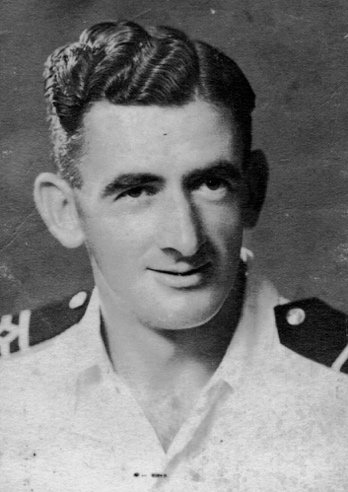
At the outbreak of the Second World War, he was working as a Junior Officer for Anglo-Saxon Petroleum Company (Later to become Shell Tankers). Regrettably, I only know snippets of his sea going career during this time, as like many people who went through these types of conflict, they were often reticent in talking about it. Two facts I do know are that he was in the Atlantic Convoys and was also bombed in Bari Italy. By the end of the War, he was serving as Chief Officer.
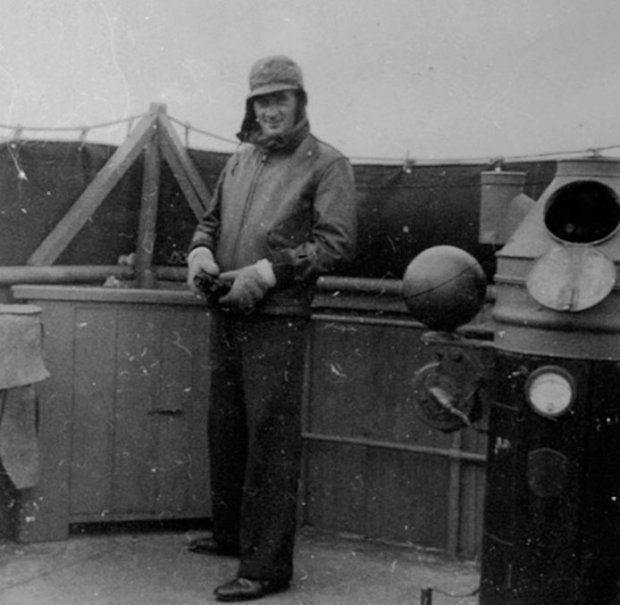
A photograph taken possibly during one of the Atlantic Convoys judging by the cold weather clothing. At times he was sailing from Halifax, Canada to the UK. The next photo was taken during down time sailing one of the Ship’s lifeboats in Halifax Bay. It was not all work and no play.

I know that my father was on a Tanker M. V. Crista, that was bombed in Bari, Italy whilst carrying a cargo of Benzine. He was one of the crew who were rescued by an RAF rescue launch from the burning sea. The following is a copy of a cutting stating that F/O A.J.T. Bridgland received an MBE for rescuing people from the sea.
“The King has been graciously pleased to approve the following award.MBE (Mil.) to F/O Arthur James Thomas Bridgland RAF”
“In December 1943 he was in command of a highspeed launch during a raid on Bari Harbour, when ammunition ships were blown up causing great damage and loss of life. He took his boat alongside a badly damaged Benzine Tanker, which was lying less than 100 yards from other burning tankers and exploding ammunition ships, in order to rescue the crew of the damaged tanker. Disregarding his own safety F/O Bridgland searched along the line of burning vessels and rescued some survivors. He also picked up others from a raft. After landing those whom he had rescued, this officer made a second trip to find the engineer of the tanker, but in this he was unsuccessful. He picked up another injured man however, but the latter unfortunately died whilst returning to shore. F/O Bridgland displayed courage of a high order on this occasion, and he has invariably set a fine example for all personnel in his unit.”
My father was quite severely injured and almost lost his sight, this was due to an American ship that was bombed, which was carrying Mustard Gas for some reason. He spent a period of time in Hospital, before being transferred to Alexandria in Egypt. F/O Bridgland stayed in the RAF and was promoted to Squadron Leader in July 1964.
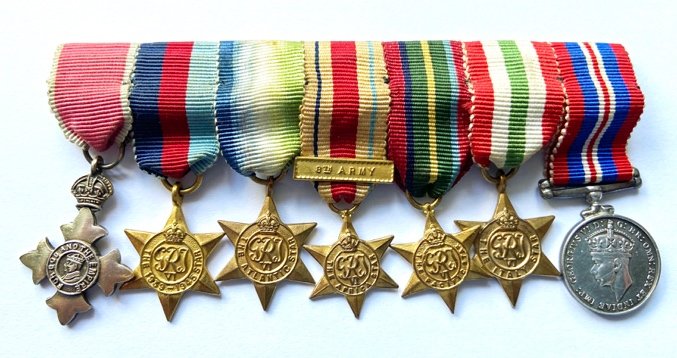
My father received the following medals on completion of the second World War.
1939 – 1945 Star
Atlantic Star
Africa Star
Pacific Star
Italian Star
1939 – 1945 War Medal
The MBE is not associated with WW2 but was presented for an act of bravery in 1952.
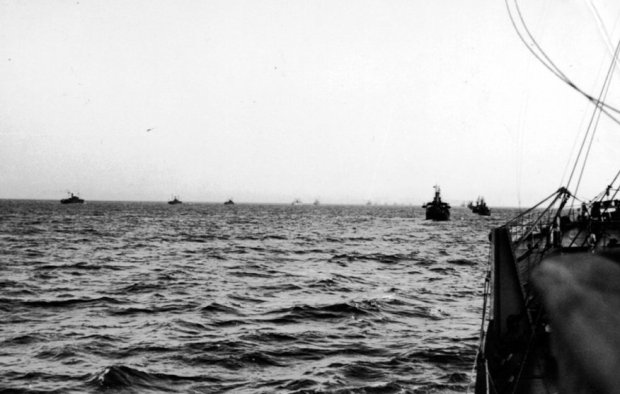
This photo was taken by my father during one of the convoys he sailed on.
All my father’s siblings served in the forces during the Second World War. His eldest brother Charles served in the Royal Navy as an Officer, participating in Atlantic and Arctic Convoys. During one of the Atlantic Convoys his ship was torpedoed but was able to return to port. As well as the above, he was also on one of the ships engaged in the “Hunt for the Bismarck” on HMS London.
His brother Tom, served in the RAF as a navigator on Mosquito aeroplanes, some of which were used as “Pathfinders” i.e. flying ahead of the bombers to mark areas to be bombed. He also spent quite some time in North Africa, where on one occasion he was able to meet up with my Father. The youngest brother Stanley also joined the RAF as a flight mechanic and, again by coincidence, serving in North Africa a lot. I believe he predominantly worked on “Hurricane” aeroplanes.
Their only sister Eluned was in the Army, serving in the UK. But unfortunately, I have no information about her service.
My father stayed in the Merchant Navy, latterly serving as Captain with Shell Tankers until 1953 when he came ashore to take up shore employment, as so many do when a family comes on the scene.
Anecdotally: – 36,749 seamen were lost to enemy action, 5,720 were taken prisoner and 4,707 were wounded, totalling 47,176 casualties, a minimum casualty rate of over 25 per cent. Gabe Thomas, the former Registrar General of Shipping and Seamen (Great Britain) stated that “27 per cent of merchant seamen died through enemy action.” A casualty rate higher than any of the armed forces.
I followed my father into the Merchant Navy, initially with Shell tankers, before working for other shipping companies, predominantly on Oil tankers. Spending 42 years at sea serving from Cadet through to Ship’s Master.
Bryan Watkins. April 2025
 Kingston Local History Society