
A Tale of Two Kingstons
On the 80th Anniversary of VE Day we will be celebrating the end of WW2 and the allies victory. For many of my generation we enjoy the freedoms we take for granted due to the bravery and sacrifice of our ancestors. For many of us our very existence is due to WW2 and the resulting movements of people and the chance meetings that brought our mums and dads together. This is the story of just one such chance meeting of the many.
This particular journey starts during WW1 with the birth of my father in Kingston-Upon-Thames, Surrey and ends with me living here in Kingston, Devon.
My dad’s early days were pretty tough. His father was a driver in the Royal Engineer’s during WW1 and his mother sadly died in childbirth when my dad was only 5. He was brought up surrounded by half-brothers and step-brothers in a small terraced house just round the corner from the Hawker Sidley factory. After leaving school at 14 he initially worked at Fyffes bananas which made him a great dad for dealing with spiders in the house but also all the free bananas he ate ensured that by the time I arrived he couldn’t stand the sight or smell of bananas- a dislike which I have strangely inherited. After several other jobs in and around SW London war was declared and like his father he joined up and joined the Royal Artillery.
978787 Mitchell enlisted on the 16th of May 1940. His occupation prior to enlistment was as a driver but no other details are known. After 1 month’s initial training as a Gunner at Bulford Camp (Wiltshire) his first brief posting was to the Thames and Medway Heavy Artillery at Sheerness Essex defending the Thames Estuary and River Medway. However, after just over a month he was transferred to the 338th Coastal Battery, this was part of the 550th Coastal Regiment responsible for the coastal defences around Folkestone in Kent. The Battery formed part of a larger system of coastal defence batteries in Kent, along the cliffs overlooking the English Channel. The battery provided anti-shipping defensive fire as well as two 40mm Bofors anti-aircraft guns. The battery included an observation post, two engine blocks as well us underground facilities including a plotting room, shelter and dressing station. During this 6 month posting during the second half of 1940 my father was appointed as a bombardier (RA equivalent of corporal). His posting to Folkestone in July 1940 coincided with Winston Churchill’s orders to bolster coastal defences with 15 inch and 8 inch high performance guns. The 8 inch guns formed part of the battery and provided cross channel defensive fire across the Dover and Folkestone area.
Like many who fought in the war he rarely spoke in any detail about his experiences, although the occasional story would be triggered when sitting down with him to watch a Sunday afternoon war film or even an episode of Dad’s Army! One such recollection was how during this posting in Folkestone he had watched the Battle of Britain unfold where part of his role was to report hits and losses on both RAF and Luftwaffe planes. Given the chaos he witnessed I have the impression that this was very much more of an art than a science and the ‘final score’ was very much a wet finger in the air estimate even before the ‘Ministry of Information’ put their inevitable spin on things.
At the end of 1940 there comes a pivotal life changing moment. On my father’s war record on 31/12/1940 he was posted to join the 12th Coastal Artillery Group. One day later the 1/1/1941 this posting was rescinded. Had this not happened he would probably have gone to Hong Kong and by the end of 1941 would almost certainly have been killed or at the very least have been captured and been a Japanese POW. Instead, just 10 days later he was on his way to Plymouth to become an instructor at the Coastal Artillery Training Centre (CATC) which was Headquartered at The Citadel on Plymouth Hoe. He was soon promoted to Sergeant and gained many new skills which would in later years help to ensure my top marks for my trigonometry homework! His people skills also developed and one of the tricks he shared with me was to quickly identify the smartest hardest working members of each training group. Then if there was ever a question on the course that he and his fellow instructor couldn’t answer they would simply say that’s a great question I wonder if our star pupils know the answer.
At the same time my mother was a young girl living with her parents in Elburton, then a village but now part of Plymstock (the bit of Plymouth to the eastern side of the River Plym). She worked as a secretary in Plymouth until one day in 1941 when she turned up at her office and it was no longer there. The Blitz had finally hit Plymouth. Despite the lack of office, eventually alternative working accommodation was found and life went on as best it could, inevitably interrupted by many nights spent in the air raid shelter which I remember the remains of in my Grandparents’ garden in Homer Rise in Elburton.
Over the next year or two raids rumbled on but with greater investment in defences and artillery around the Plymouth area the impact was reduced. I like to think that one such artillery improvement was the presence of my dad in Plymouth. At this time his role was as an instructor teaching newer recruits to use the guns. Initially stationed at the Citadel in Plymouth he later spent time at Fort Staddon (Staddon Heights where I would later learn to play golf). Located on the eastern side of Plymouth Sound, just a short Sunday afternoon route march to Elburton! And so our scene is set for that chance meeting that would change everything (especially the odds on my existence). My grandmother had been brought up going to the Methodist Mission in Plymouth and so when she and my grandfather moved to Elburton she naturally became a regular worshipper at Elburton Methodist Chapel and my mum would become a Sunday School teacher. One Sunday afternoon they laid on tea and home made cakes for the local soldiers from the area and fortunately for our story it was my mum who served my dad tea. I have no idea whether it was the quality of the tea, the cake, the twinkle in my dad’s eye or his arguably very slight passing resemblance to Bing Crosby that sealed the deal but as they say the rest is history!
So they dated as best they could during war time, including dancing on Plymouth Hoe, but despite my dad finally seeing service abroad towards the end of the war the die had been cast and they would be reunited after the war and married in that very same church where they had met and where I would be christened.
However, I must not skip over that posting abroad as this is the setting for my most enduring memory of my dad’s army tales. It was two months after VE Day July 1945 and my dad was posted to Belgium to act as a guard at POW camps for captured German soldiers. A key function of the second camp was to try and separate SS Officers (who would be sent for specialist interrogation and potentially trial) from the rank and file soldiers who were to be repatriated to Germany. As the war ended the relationship between the British guards and these ordinary German soldiers developed and the atmosphere became more relaxed – they came to realise that they were not that different and had been doing the same job (that none of them wanted) just for different taskmasters. They would chat as best they could despite the language barriers (I remember my dad shouting Schneller at me as a child if he wanted me to hurry up) and play cards and other games, including chess. I still have the chess set that was given to my dad by one of the POW’s. Despite this slightly more relaxed atmosphere, one of the key duties was the daily headcount to ensure there had been no escapes. One morning a hole was discovered cut in the perimeter fence and it appeared there had been an escape. However, at the headcount no one was missing. So the hole was repaired, but a few days later the same happened a hole was found but no prisoners had escaped. After this happened a third time additional night watches were introduced, and a small group of German prisoners were spotted ‘escaping’. When questioned the strange truth was that they had simply been going out for the evening to meet up with some girls in the local Belgian village before returning to the POW camp.
Since obtaining my dad’s war records and spending some time looking at War Diaries at the National Archives, I was able to retrace his journey to Belgium and found the sites of the two POW camps. The first was just a field and had simply been a huge campsite POW camp (from the descriptions I have read these sites were like giant Glastonbury’s but without bars and music and with even worse toilet facilities!) The site of this camp is now marked by a simple plaque on the side of the road. However, the second camp location took some finding as all I had to go on was the name of the small town although I do remember my father saying that prisoners were transported into and out of the site by train. There was nothing on the maps in the town to indicate the site of the camp and looking at satellite images revealed several possible sites in the local area. So I found the local library where fortunately there was a young lady who spoke enough English to understand what I was looking for. Sadly, not only did she not know the site she was totally unaware that there had ever been a POW camp in the area. She asked a few of her colleagues to no avail until one pointed to an older lady. Using the librarian as an interpreter we were able to pinpoint the location on a map as the lady remembered stories from her parents about the camp. The site had been used for military purposes since at least Napoleonic times but was now completely overgrown. Despite the risk of being arrested for trespassing I found the remains of the core of the camp and later the remains of the railway siding where prisoners were disembarked for processing and later embarked for repatriation (or in the case of the SS for trial).
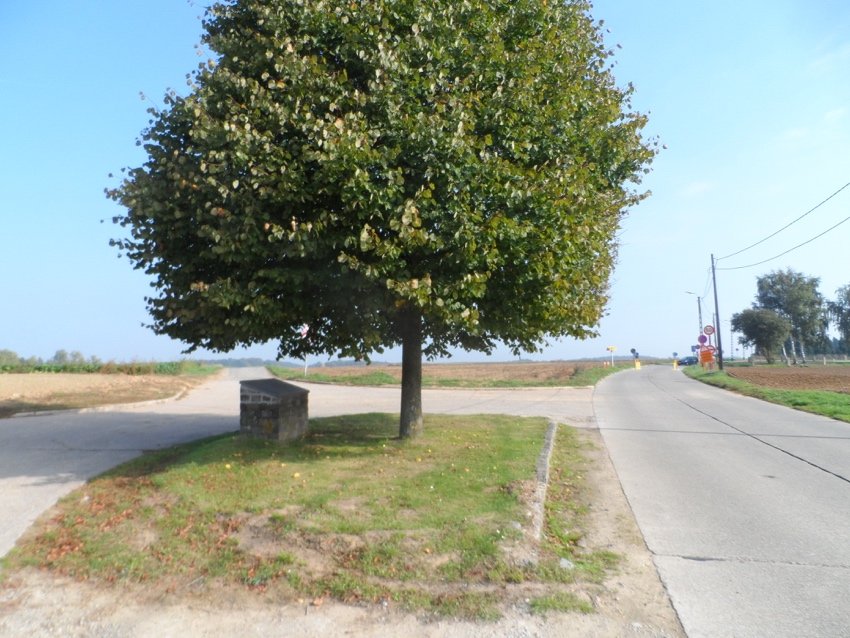
Above and below – Plaque marking location of POW Camp 2228 nr Terlanen, Belgium


Above and below – Location of POW Camp 2223 near Brasschaat, Belgium

 Kingston Local History Society